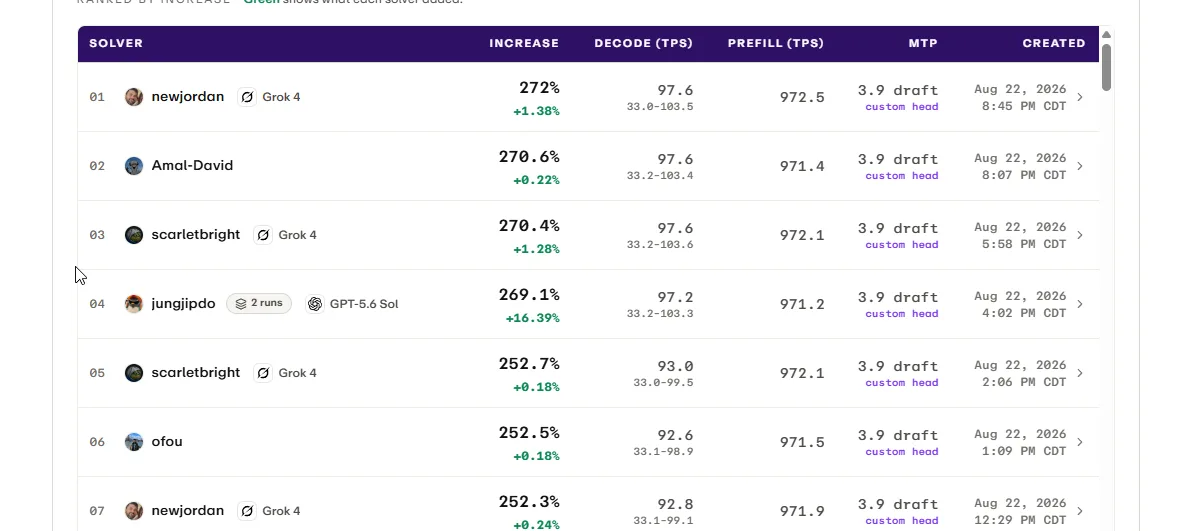
We help companies adopt AI and stop renting it. Custom models, agents and the software around them, running in your building, on your data, at a fraction of the cloud bill. Our published builds run 1.3× to 3.7× faster than stock on the same hardware, with quality measured, not assumed. We won Yukon's MLX.fast challenge with a 272% speedup on Qwen 3.8. Every result comes with a benchmark you can re-run.
Most AI spend is rent. Per-token API bills, per-seat subscriptions, and your data leaving your control. Open models are now good enough to do much of that work on a machine you own. The gap is engineering: picking the right model, making it fit, making it fast, and building the product around it so people actually use it. We close that gap, end to end.
We find where AI actually pays off in your operation, choose the right open model for each job, and put it on hardware you already have or one well-chosen box. Nothing leaves the building.
Replace metered API calls with local inference. We compress and tune models so they fit smaller, cheaper hardware and run faster on it, without losing the quality you need. Before-and-after numbers, every time.
Fine-tunes trained on your documents and workflows. Agents that do one job reliably, with evaluations that show exactly where they succeed and where they don't.
The model is a third of the job. We also build the application around it: web apps, dashboards, integrations, terminal tools, installers. Full stack, shipped and maintained.
Jordan Newman founded and runs Omnispace. He works at every layer: GPU kernels merged into the engine most local AI runs on, published models thousands of people download, and complete customer-facing applications. The numbers below are public and reproducible.
REAL-WORLD SPEEDUPS · published builds, method and numbers in each model card
| model, hardware | stock | ours | gain | quality |
|---|---|---|---|---|
| Qwen 3.8 27B, Mac, MLX.fast challenge | 1.00× | 3.72× | +272% | won, #1 final board, exact output |
| Qwen3.8-27B, one GPU | 21.6 t/s | 31–40 t/s | +45–91% | KL-validated, top-1 99.8% |
| Nex-N2 35B MoE, Intel Arc Pro B70 | 68.8 t/s | 88.1 t/s | +28% | 94% top-1 agreement |
| same, at 131k context | 20.0 t/s | 42.3 t/s | +112% | same build |
| Laguna-XS-2.1, Intel Arc Pro B70 | ~107 t/s | ~152 t/s | +42% | top-1 92.8% vs 91.7% stock |
| Gemma 4 26B, Mac, MLX.fast | 1.00× | 2.41× | +141% | organizer-verified, exact output |
WHAT 272% MEANS FOR YOUR BILL
Inference cost is hardware-time. Run the same model 3.7× faster and each request costs about a quarter, or one box does the work of nearly four. Even the 1.3× cases cut a bill by a fifth. This is the work above, applied to your model on your hardware.
LLAMA.CPP · four pull requests merged in 2026, reviewed by the maintainers
fused MoE routing · K-quant MoE matmuls · residual/norm fusion for Intel GPUs · chat-template fix · #25217 #24452 #27610 #24674
plus 20 more merged PRs in other teams' repos: inference stacks, agent frameworks, game engines, an MQTT broker
PUBLISHED MODELS · 33 on Hugging Face · quantized, validated builds of Qwen, Gemma-class MoEs, Laguna, Muse, Ornith, Leanstral
COMPETITION · winner, Yukon MLX.fast Qwen 3.8 track (272%, Aug 2026, final board) · 100+ record-setting entries across six more Yukon challenges, Jul–Sep 2026, organizer-verified
Model-card numbers are self-measured with the method stated beside them. Yukon numbers are organizer-verified.
Tell us what you're paying for AI today and what you wish it did. We'll tell you honestly whether custom, local AI will save you money, and what it would take.
OMNI BIOS 0.98
Copyright (C) 2026 Omnispace Technologies
C:\OMNI> enter.exe
Loading OMNISPACE 98